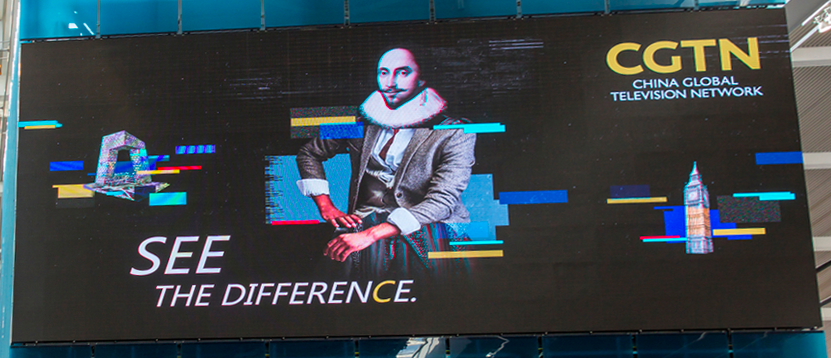
UK media regulator Ofcom announced on 4 February that it has withdrawn the licence for CGTN to broadcast in the UK. The regulator gave details of its decision, stating that “…after its investigation concluded that the licence is wrongfully held by Star China Media Limited.”
Ofcom’s statement on the affair said:
“China Global Television Network (CGTN) is an international English-language satellite news channel.
In the UK, broadcasting laws made by Parliament state that broadcast licensees must have control over the licensed service – including editorial oversight over the programmes they show. In addition, under these laws, licence holders cannot be controlled by political bodies.[1]
Our investigation concluded that Star China Media Limited (SCML), the licence-holder for the CGTN service, did not have editorial responsibility for CGTN’s output. As such, SCML does not meet the legal requirement of having control over the licensed service, and so is not a lawful broadcast licensee.
In addition, we have been unable to grant an application to transfer the licence to an entity called China Global Television Network Corporation (CGTNC). This is because crucial information was missing from the application, and because we consider that CGTNC would be disqualified from holding a licence, as it is controlled by a body which is ultimately controlled by the Chinese Communist Party.
We have given CGTN significant time to come into compliance with the statutory rules. Those efforts have now been exhausted.
Following careful consideration, taking account of all the facts and the broadcaster’s and audience’s rights to freedom of expression, we have decided it is appropriate to revoke the licence for CGTN to broadcast in the UK.
We expect to conclude separate sanctions proceedings against CGTN for due impartiality and fairness and privacy breaches shortly.
Ofcom’s investigation
Our investigation found that SCML does not have editorial responsibility for selecting or compiling CGTN’s programme schedule. It is the distributor of the CGTN service in the UK, rather than “the provider” of the service.[2]
In addition, none of the employees involved in CGTN’s decision-making, or day-to-day running of the channel, appear to be employed by SCML. CGTNC confirmed that its Global Editorial Board is the ultimate decision maker over the selection and organisation of programmes for the CGTN service and exercises editorial control.
CGTN’s licence transfer application
In response to our enquiries, CGTN accepted that SCML did not control the channel and should no longer hold the licence. But it confirmed its intention to restructure to separate the CGTN division from China Central Television (CCTV) – which is ultimately controlled by the Chinese Communist Party and so disqualified from holding a UK broadcast licence[3] – and apply to transfer the licence to an entity which did control the channel.
Given the revocation of a broadcast licence is a significant interference with a broadcaster’s right to freedom of expression, we considered it appropriate to allow CGTN a reasonable period of time to come into compliance.
An application to transfer the licence to CGTNC was submitted in September 2020. However, we were unable to properly assess it. Crucial information was missing from the application, while the restructure that CGTN had signalled had not, and still has not, taken place.
CGTN has since repeatedly failed to respond to important questions necessary to our assessment of its application to transfer the licence, or to offer any update on progress with its restructure.
Links between CGTNC and CCTV
Having considered the available evidence, we have decided we are unable to grant the application to transfer the licence from SCML to CGTNC.
Correspondence from CGTN submitted during the course of our investigation makes clear that CGTNC is controlled by CCTV, which is also the sole shareholder of CGTNC.
Given CGTNC is controlled by CCTV – which, as part of the China Media Group, is controlled by the Chinese Communist Party and therefore disqualified from holding a broadcast licence under UK broadcasting laws – we consider that CGTNC would be disqualified from holding a licence.
An Ofcom spokesperson said: “Our investigation showed that the licence for China Global Television Network is held by an entity which has no editorial control over its programmes. We are unable to approve the application to transfer the licence to China Global Television Network Corporation because it is ultimately controlled by the Chinese Communist Party, which is not permitted under UK broadcasting law.
“We’ve provided CGTN with numerous opportunities to come into compliance, but it has not done so. We now consider it appropriate to withdraw the licence for CGTN to broadcast in the UK.”
Other CGTN cases
In 2020 we found CGTN in breach of the Ofcom Broadcasting Code for failing to preserve due impartiality in its coverage of the Hong Kong protests, and also found a serious breach of our fairness and privacy rules.[4]
Due to the seriousness of these breaches, we told CGTN that we would consider imposing sanctions.
Today’s decision does not affect these sanctions proceedings against CGTN, and we expect to reach our decisions shortly.
We have three other fairness and privacy investigations about content on the CGTN service which also remain ongoing, pending further consideration.”
CGTN has been monitored still broadcasting to the UK via the Freesat platform at the headquarters of the AIB at 1530GMT on 4 February.
UPDATE: The service ceased on Freesat at 1638GMT.