16 October 2014

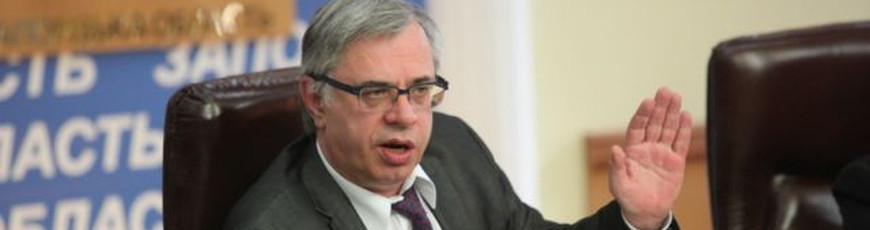
Yuriy Artemenko at a meeting in Zaporizhia of media representatives (photo courtesy of NRADA)
The Ukrainian media regulator has moved to ban the broadcast of Russian TV channel 365 Days and Belarusian channel Belarus 24.
On October 15, the Ukrainian National Council for Television and Radio Broadcasting decided to ban the two channels. 365 Days is a Russian history channel. Belarus 24 is the state television and radio channel of Belarus.
In a briefing in Kiev, National Council head Yuriy Artemenko said the decision was based on both channels’ violating clauses of the European Convention on Transfrontier Television (full text of the Convention). Artemenko said the Council will now turn to the courts, to request an official ban of the channels across Ukraine.
The Council’s Deputy Chairman, Grygoriy Shverk, said court hearings against six Russian TV channels were currently underway in the country.
According to a statement on the Council’s website, the decision to ban Russia’s 365 Days was prompted by a complaint and by monitoring conducted by the Council. The Council specifically cited an episode of the programme History of Russia, XX Century, “On the Threshold of Victory”, broadcast by 365 Days on September 9, which it said presented false information about historical events in Ukraine, incited national hatred and had the potential to harm the development of children and adolescents.
Selective monitoring of Belarusian channel Belarus 24 also revealed anti-Ukrainian propaganda and a distortion of information on political developments in Ukraine, said the Council’s site.
Article 24 of the European Convention on Transfrontier Television provides for the settlement of disputes and alleged violations:
1 When a Party finds a violation of this Convention, it shall communicate to the transmitting Party the alleged violation and the two Parties shall endeavour to overcome the difficulty on the basis of the provisions of Articles 19, 25 and 26.
2 If the alleged violation is of a manifest, serious and grave nature which raises important public issues and concerns Articles 7, paragraphs 1 or 2, 12, 13, paragraph 1, first sentence, 14 or 15, paragraphs 1 or 3, and if it persists within two weeks following the communication, the receiving Party may suspend provisionally the retransmission of the incriminated programme service.
3 In all other cases of alleged violation, with the exception of those provided for in paragraph 4, the receiving Party may suspend provisionally the retransmission of the incriminated programme service eight months following the communication, if the alleged violation persists.
4 September 2014
 PRESS RELEASE
The Association for International Broadcasting has announced its panel of judges for its tenth annual international broadcasting awards, the AIBs 2014. The senior media executives who make up the independent panel come from all across the world and will judge the best in global factual radio, TV and online broadcasting.
CRANBROOK, UK 04 SEPTEMBER 2014 – The panel of 50 senior international media experts brought together by the AIB (Association for International Broadcasting) to judge the AIBs 2014 represents TV, radio and online broadcasting from all across the globe with in-depth knowledge of commissioning, writing, producing, editing and distribution. They have extensive experience in current affairs, investigative documentaries, short documentaries, children’s programmes, sport, science, transmission and broadcasting technology and will be bringing their insight and extensive knowledge to the judging the record number of entries received for this year’s awards which have come from all over the world.
“We are grateful to our panel of experts for agreeing to give up their time to judge the awards” said Simon Spanswick, CEO of the Association for International Broadcasting. “Their diversity of backgrounds and wide experience, coupled with the fact that they are free to choose the best entries without being influenced by any vested interest, ensures that the AIBs will continue to reward the very best of international broadcasting.”
The AIBs 2014 judges are:
- Faisal Abbas, Editor-in-Chief English online, Al Arabiya MBC
- Neeraj Arora, EVP Head of International Business, MSM Asia Limited/Sony Entertainment Network
- Tim Ayris, Director Channel and OEM sales EMEA, thePlatform
- Amadou Ba, Co-founder and Executive Chairman, All-Africa Global Media Inc.
- Hannelie Bekker, Founding MD, Wananchi Programming
- Klaus Bergmann, Director of International Relations, Deutsche Welle
- Graeme Blundell, The Australian
- Jenny Buckland, CEO, Australian Children’s TV Foundation
- Fernando Calvino, CEO/Owner, Señal Internacional
- Catherine Cano, Executive Director News Programs CBC/ Radio-Canada
- Rahul Chopra, SVP Global Head of Video, Newscorp
- Eugen Cojocariu, Head of Radio Romania International
- James Cridland, Radio Futurologist
- Verona Duwarkah, GE: Television, SABC
- Anastasia Ellis, Head of Europe TV, Bloomberg
- Géraldine Filiol, Deputy Managing Director, Eurosport
- David Finch, VP Europe, News Republic
- Marco Frazier, Senior Vice President Global Distribution, AMC Networks International (AMCNI)
- Angela Fung, Phoenix Satellite TV
- Mihai Gadea, CEO, Antena 3
- Lee Gal, Chief producer, i24 News
- Sumit Grover, Director, Pixel Party
- Mohamed Ali Harrath, CEO, Islam Channel
- Sven Herold, VP Creative Development, Shell
- Carlson Huang, Vice Manager and English Program Host, RTI
- Richard Jacobs, Business Development Director, Babcock International Group
- Emmanuel Josserand, Marketing Director, Civolution
- Bettina Klauser, Head of Press and PR, N-tv (Mediengruppe RTL Deutschland)
- Cheryl Knapp, Series Producer, Wild Kratts
- Nathalie Lenfant, Marketing Director, France Medias Monde
- Marcus Metzner, Head of Marketing Services and Communication, arvato Sysyems
- John Momoh, CEO, Channels TV
- Alexey Nikolov, Managing Director, RT Channel
- H Nwana, Executive Director, Dynamic Spectrum Alliance
- Lemi Olalemi, Deputy CEO, TVC News
- Lindsey Oliver, International Media Consultant
- John O’Loan, CEO, iO Media Group Europe
- Nenad Pejic, Editor-in-Chief, co CEO, RFE/RL
- Jonathan Perelman, Vice President Motion Pictures, Buzzfeed
- Helen Stehli Pfister, Producer/Editor, Schweizer Radio und Fernsehen
- Tom Porter, Commissioning Editor, Channel 4
- Libby Powell, CEO, Radar
- Paul Robinson, CEO, Creative Media Partners
- Gillian Rose, Managing Director, PBS Distribution
- Alla Salehian, CEO, TIMA
- Vatche Sarkisian, Director of Program Review, MBN (Alhurra/Radio Sawa)
- Ruth Sloss, Director of Programming, Spafax
- Simon Spanswick, CEO, AIB
- Lek Hwa TAN, VP English Current Affairs, Channel NewsAsia
- Htar Swe TIN, Editor South East Asia and Burmese Service, BBC
The list of judges, with links to their biographies of the judges can be found at theaibs.tv/aibs-2014-judges/.
The AIBs are now in their tenth year and are independent of commercial interest. They attract entries from throughout the world, representing the best of international factual broadcasting. The 15 different categories to be judged cover radio, television and online media across a broad spectrum from single news events to long-term investigation with special categories for children’s programmes, for sport and for coverage of science. The categories also include awards for radio and television personalities of the year.
The winners of the AIBs will be announced at the AIB awards gala on Wednesday 5 November 2014 which will be held at LSO St Luke’s in London.
The AIBs 2014 are sponsored by Eutelsat

Contact
For further information please contact
Roger Stone, AIB
roger.stone@aib.org.uk
T +44 (0)20 7993 2557
AIB, PO Box 141, Cranbrook TN17 9AJ, UK
About the AIB
Established in 1993, the AIB is the international industry association and global knowledge network for the international broadcasting industry– cross-media, cross-border, cross-cultural. With a reach of over 25,000 communicators and media professionals, AIB is a unique centre of information about international broadcasting, covering TV, radio, online and mobile. AIB researches regular market intelligence briefings for its members and provides client-specific consultancy and project support. Members receive an extensive package of services throughout the year. AIB publishes the comprehensive Global Broadcasting Sourcebook and the international media magazine, The Channel. AIB hosts the annual AIB International Media Excellence Awards – the “AIBs”. For more information, visit www.aib.org.uk and theaibs.tv or call +44 (0) 20 7993 2557
About Eutelsat
Eutelsat is one of the world’s leading and most experienced operators of communications satellites. The company provides capacity on 36 satellites to clients that include broadcasters and broadcasting associations, pay-TV operators, video, data and internet service providers, enterprises and government agencies. Eutelsat’s satellites provide ubiquitous coverage of Europe, the Middle East, Africa, Asia-Pacific and the Americas, enabling video, data, broadband and government communications to be established irrespective of a user’s location.
For more information, visit www.eutelsat.com
AIB | PO Box 141 | Cranbrook | TN17 9AJ | United Kingdom
T +44 20 7993 2557
F +44 20 7993 8043
www.aib.org.uk

30 May 2014

AIB is delighted to welcome Sony Entertainment Television as a member of the Association for International Broadcasting.
Sony Entertainment Television is the international destination of choice for toprated light entertainment and dramedy
30 May 2014
At the request of AIB members and others in the international media industry, we are extending the closing date of this year’s AIBs.
Join entrants from around the world who have submitted their outstanding work to this year’s annual call for entries to global awards for best factual TV, radio and online broadcasting.
Download the AIBs 2014 entry booklet here with full details of how to enter.
There are awards for live journalism, current affairs and investigative documentaries, children’s factual programmes or series, science programmes or scientific coverage, live sports, short documentaries, online factual productions, creative features and international on-line talent for both TV and radio.
The revised closing date for entry to the awards is 8 August 2014.
We launched the AIBs 2014 at an event in London attended by past winners, along with key people from the international media industry.
[flickr_set id=”72157644779884611″]