29 December 2014
The Association for International Broadcasting today condemned the detention of Baku-based staff of RFE/RL and a raid on the broadcaster’s bureau in the Azerbaijani capital.

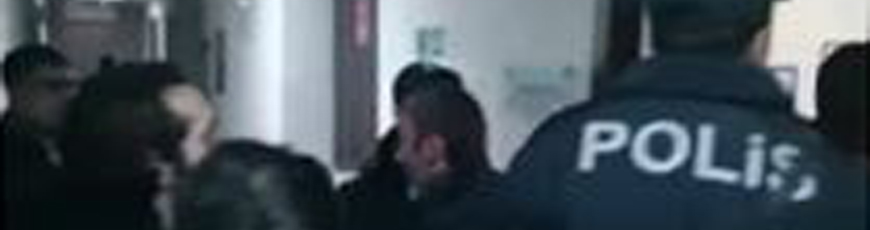
Police detain RFE/RL staff in Baku, Azerbaijan
The raid on RFE/RL’s bureau took place on 26 December, seizing documents, computers, memory sticks and other items. The office was then sealed, preventing staff from accessing the bureau. The following day the first of a series of raids on homes of RFE/RL employees in Baku began, with a number of staff – including the bureau’s cleaner – detained. No charges have been brought against any of the RFE/RL staff.
“It appears that Azerbaijan is continuing a comprehensive campaign against the freedom of expression and the press,” said Simon Spanswick, chief executive of AIB. “This latest act follows the detention in February and most recently in December of Azerbaijani journalist Khadija Ismayilova, who contributes to RFE/RL and other media outlets. The raid on RFE/RL’s bureau in Baku and the detention of many of the station’s staff – including the office cleaner – shows a total disregard for media freedom in the country. AIB calls on the authorities to cease this campaign of intimidation and allow free reporting in Azerbaijan.”
The raids and detention of RFE/RL staff comes as the broadcaster is under investigation as a “foreign-funded entity”. The offices of a range of non-governmental organisations including the International Research and Exchanges Board (IREX), the Institute for Reporters’ Freedom and Safety (IRFS) and the Media Rights Institute were raided and sealed in August 2014.
International radio stations – including the BBC, Radio Azadliq (the Azeri-language service of RFE/RL), and Voice of America – were taken off the air in Azerbaijan in 2008. International stations have broadcast on satellite or via the Internet since then.
The raids come soon after Azerbaijan’s six-month presidency of the Council of Europe ended in November. The Council of Europe is an international organisation promoting co-operation between all countries of Europe in the areas of legal standards, human rights, democratic development, the rule of law and cultural co-operation.
“Azerbaijan has sought to position itself as an important player both regionally and in the global arena,” commented Spanswick. “These latest moves are against international broadcasters and non-governmental organisations that are seeking to assist in the development of Azerbaijan. The raids demonstrate that the country is retreating from the international stage, rather than taking its place on it. It is time to once again move forward. The country can demonstrate this through ceasing the harassment of journalists and NGOs. Instead, the country should uphold the ideals of the Council of Europe.”
AIB will be raising the matter with the Azerbaijan Ambassador in London and with the authorities in Baku.
29 December 2014
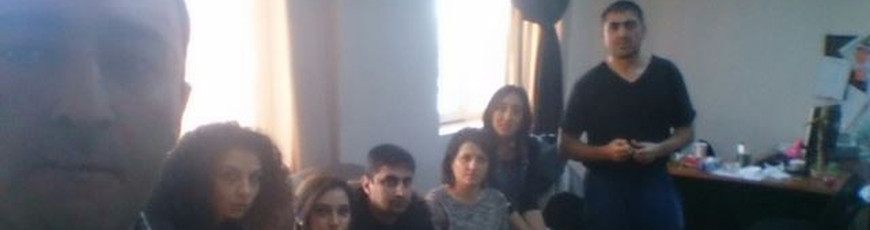
 Twelve employees of RFE/RL’s Baku bureau have been forcibly detained by Azerbaijani authorities for questioning, with more ordered to appear for questioning today or face similar detentions.
All 12 were released without charge on December 28 after being questioned for up to 12 hours in the latest crackdown against the activities of RFE/RL’s Azerbaijani Service, known locally as Radio Azadliq. Those summoned for questioning were not allowed representation by a lawyer.
Journalists with RFE/RL’s Azerbaijani Service reported Saturday that police were pursuing them individually, going directly to their homes to take them in for questioning following a raid on the service’s Baku bureau on Friday.
In a move the news bureau’s legal team called “unprecedented – even by Azeri standards,” police late in the evening on December 27 knocked on the doors of at least four bureau reporters demanding that they accompany them to the prosecutor’s office for questioning. An additional eight journalists were told to report for questioning on Monday.
“These people are being dragged to the prosecutor’s office by force and by threats,” said one of the lawyers, who asked that his name be withheld out of concerns for his personal safety. “By being summoned over the weekend, they are being denied the opportunity to have any legal defense, despite the fact that by Azeri law a witness is normally summoned by phone or official summons to enable a lawyer to be present.”
RFE/RL Editor in Chief and Co-CEO Nenad Pejic condemned the police action, and said Azeri authorities are “terrorising our staff and their families.”
In one case, a journalist’s mother answered the door and was told by police that RFE/RL’s bureau is closed and that the daughter must go with them to have “a conversation.” In addition to the journalists, the bureau’s cleaning woman was also confronted at her home by Azeri police.
The employees, who have all requested legal representation for their questioning sessions, have been told they will be taken by force to the prosecutor’s office if they do not cooperate. A lawyer for the bureau who demanded that his clients’ right to counsel be respected was threatened by Iqbal Huseynov, a senior investigator in the case, with being disbarred.
Siyavoush Novruzov, deputy executive secretary for the ruling Yeni Azerbaijan Party, commented on the raid on Friday, characterizing it as a national security issue. Speaking to the local web portal Media Forum, he said, “Every place that works for foreign intelligence and the Armenian lobby should be searched.”
In a related development, a Baku court yesterday heard and rejected the appeal of investigative reporter and RFE/RL contributor Khadija Ismayilova, who remains in prison after being sentenced on December 5 to two months’ detention on charges of inciting a colleague to attempt suicide.
22 November 2012
INSI, the International News Safety Institute, has issued advice for journalists travelling to Goma. It says EXTREME CAUTION SHOULD BE EXERCISED IF TRAVELLING TO GOMA.
The recent takeover in Goma by March 23 (M23) is the fourth time the country has fallen to rebel hands since its independence from Belgium 52 years ago. On Tuesday 20 November the FARDC (the Congo National Army) was pushed out of Goma and MONUSCO, the United Nations Organization Stabilization Mission in the DRC, was unable to stop it. MONUSCO was authorised to use force to protect civilians and support Congolese army operations against rebel groups and militias competing for control of mineral wealth. The UN backed the army with attack helicopters but the soldiers disappeared when M23 approached the city.
The situation is much calmer today (Wednesday 21 November) and M23 are trying to bring a sense of security to the town. Some 2,000 army troops and 700 police turned in their weapons at a large M23 rally at the stadium in Goma this morning.
There are still some UN peacekeepers in Goma but they have no power to do anything.
M23 said today that they would continue their march through the DRC.
GOMA AIRPORT
It is unclear who is in control of the international airport, a strategic location as it is a vital lifeline for business and aid flights.
It has been reported that the M23 controls the civilian areas around the international airport, but that the airport itself is still under UN control. The airport is divided into the military side and the civilian side.
However there is also a view that the airport was seized by M23 yesterday morning, along with the rest of Goma.
GOMA TOWN
The situation was volatile yesterday (Tuesday 20 November) as gun battles in the streets raged on between FARDC and M23.
The situation was much calmer today, as the army had left. There have been unconfirmed reports that the army has fled either to Sake, in the east of North Kivu, or to the south, but there is no concrete evidence of this (n.b.. Reuters reported today that Sake has been taken by the rebels).
Although there is still some UN presence in Goma, they remain “impotent”.
The FARDC declared today that they have withdrawn to regroup and reinforce, however there is skepticism as to whether this will happen. Security forces are poorly paid by the Congolese government and at an M23 rally at the stadium in Goma today (n.b. The impression was that they “surrendered’) the security forces were seen approaching the rebels and asking for a higher pay.
JOURNALISTS
Journalists are advised to stay on the main roads and to avoid going into smaller residential areas. Smaller residential areas are like warrens, and difficult to get out of once you’re in.
Over the past six weeks it has become increasingly difficult to travel at night because motorcycle taxis no longer operate at night, and travelling alone is too dangerous. Some journalists choose not to travel at night for security reasons. INSI cannot recommend that journalists travel at night in this area nor take local motorbike taxis.
Reporting can be difficult because of poor telephone lines and no internet.
The general consensus is that western journalists are able to operate freely.
However the situation is difficult for local journalists who are rejecting the rebellion. The state owned radio in Goma has been taken off air and many government media workers are fleeing the area. Some are agreeing to work with M23. Some local journalists are not being harassed by M23 at all.
WORKING OUTSIDE GOMA
This morning the FARDC were deployed to some parts of Goma and there were some reports of sporadic gunfire. The fighting did not last long. Later, M23 seized Sake. They said today that they plan to capture Bukavu, the capital of South Kivu province. At the time of writing, the rebels were reportedly heading to Minova, to the south of Sake.
It is believed that M23 may move to Minova, then Bukavu, then has aspirations to take the whole country. It is thought there will be little resistance because of low morale (poor pay, etc.) in the Congolese army. The other option, that M23 retreats, seems less and less likely.
Extreme caution should be exercised if choosing to work outside Goma.
WHAT DOES THE FUTURE HOLD?
A meeting is to be held Thursday 22 November at 0700 GMT between M23 and the newly recruited / surrendered security forces to discuss their role. The rebels were initially greeted by the civilian population as they entered Goma yesterday, but there are pockets of anger directed towards the UN, who failed to protect it. This anger was directed towards westerners in general as often the civilian community fails to distinguish between the UN, western media and other NGOs.
It is difficult to gauge the mood of the civilian population and difficult to determine whether the rebels are feared or not. there was a risk of looting, although Col Seraphin Mirindi, of M23, gave these new security forces the order not to loot today.
M23 has been handing out mobile numbers on bits of paper to the civilians, to alert them of any incidents – “an informal 999”. There have been reports of small arms going around, and there was sporadic gunfire yesterday evening and last night but it was short-lived.
Contact INSI if you require an equipment list or further information for working in hostile environments – Hannah Storm, Director hannah.storm@newssafety.org
Note – INSI has collated this information from journalists on the ground. It has checked its authenticity as much as it can, however can not take any responsibility for ensuing problems as a result of this information.
15 June 2012
Journalists deploying to Poland and Ukraine for the Euro 2012 football competition should be aware of safety and security issues they may encounter there.
Violence flared when Polish and Russian fans clashed before a game earlier this week. According to reports, water cannons, tear gas and rubber bullets were used to disperse the mob while fireworks, bottles and other makeshift missiles were thrown by fans from both sides. It was reported that 183 people were arrested and 24 were wounded.
Football crowds are notoriously unpredictable – a crowd can quickly turn aggressive, particularly if fuelled by alcohol. Camera crews could be a target for attack. Equally an overreaction by the police can cause a situation to escalate.
Recent BBC investigations have uncovered evidence of racist violence and anti-Semitism in Polish and Ukrainian football matches, and the British Foreign Office advises that “travellers of Asian or Afro-Caribbean descent and individuals belonging to religious minorities should take extra care.”
Journalists travelling by car have also expressed concerns about road safety in Ukraine, with poor road surfaces and the occasional disregard for driving rules.
The International News Safety Institute issues the following safety advice for journalists operating in Poland and Ukraine for the Euro 2012 football competition:
Covering civil unrest
Before you head out
• Make sure your accreditation is in order and easily accessible.
• Alert authorities that your news organization plans to cover the protests, and obtain the cell number of the person in charge.
• Take protective gear. This can include helmets, gas masks, or vests, depending on what the local police force uses for crowd control.
• In case of tear gas, carry a bandana soaked in onion, lemon, or vinegar, which neutralizes irritation.
• Don’t wear contact lenses. Bring eye drops and spare glasses.
• If there’s a chance you might be pepper-sprayed, don’t wear face cream or cosmetics. They burn on contact.
• Wear comfortable boots that you can run in.
• Wear natural fabrics, which are less flammable than synthetic fabrics.
• Prepare a backpack with supplies to last a day: lightweight raingear, energy bars and water, spare batteries for electronic equipment.
• Pack a medical kit and know how to use it.
• Carry a photocopy of your press accreditation and telephone numbers of your editor and lawyer. Make sure your editor knows how to reach your family in case you’re arrested or hurt.
• Set your cell phone to speed dial an emergency number.
• If possible, explore the terrain ahead of time. Are there stores you can dart into? Can you arrange to film from a high vantage point? Negotiate a “safe” place where you can retreat if mayhem erupts.
At the scene
• Don’t go alone. Get someone to watch your back if you’re shooting pictures.
• As soon as you arrive, spot escape routes and look for landmarks like a tall building or lamppost. It’s easy to get disoriented in a crowd.
• Stay on the edge and do not get caught between police and protestors.
• Crowds have a life of their own. Stay aware of the prevailing mood.
• Alert your editors if the scene turns angry.
• Stay away from aggressive people. They may provoke a violent response.
• If planning to move, seek advice from people who have just come from the direction you’re heading.
• Television crews should travel as light as possible. If experiencing aggression, leave the tripod behind so that you can run fast. Consider concealing cameras / recording equipment as best you can when in a crowd.
• Consider your profile and try to portray anonymity in terms of where you are from and what you do e.g. remove logo’s from clothing.
• Consider that alcohol can lead to violence so be aware in and around bars.
Be aware of the signs of a deteriorating situation
• An increase in the noise level
• A change in the tension or mood of the crowd
• Sudden crowd surges
• The occasional missile thrown
• More aggressive behaviour vocally or physically
• The police adopting a more aggressive posture, perhaps with the donning of helmets and shields or restricting the crowd’s freedom of movement
When trouble erupts
• Avoid horses. They bite and kick.
• Stand upwind from tear gas.
• Do not position yourself between the police and the crowd.
• If the police detain you, insist that they call the cell phone of their boss, whose number you just so happen to have.
• Call your lawyer (if they are local and on standby) and editor
• Maintain a safe distance from violence.
INSI is monitoring the safety of journalists covering Euro 2012 and asks anybody with information on any incidents involving journalists to contact Rodney Pinder + 44 7734 70 92 67 rodney.pinder@newssafety.org; or Hannah Storm +44 7766 814274 hannah.storm@newssafety.org


