9 July 2018
US Department of State, Broadcasting Board of Governors, OSCE denounce the move
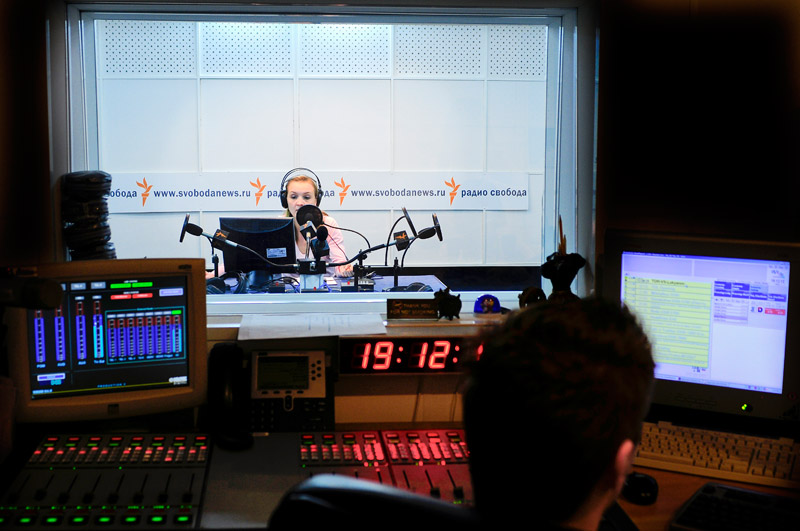
Radio Free Europe/Radio Liberty (RFE/RL) reported on 05 July that it had been fined by a Moscow district court for allegedly failing to comply with a Russian law regulating media outlets branded by the government as “foreign agents”.
The ruling comes seven months after the Russian Justice Ministry classified the following nine US international broadcasting and news services as “foreign agents”: Voice of America (VOA), RFE/RL, Current Time TV (the Russian-language TV network run by RFE/RL in cooperation with VOA), and six RFE/RL affiliated news services: the Tatar-Bashkir Service of RL (AzatliqRadiosi), Sibir.Realii, Idel.Realii, Faktograph, Kavkaz.Realii, Crimea.Realii.
“Sharp new escalation (…) worrying and unacceptable”
 RFE/RL President Thomas Kent said the prosecution of RFE/RL was a “sharp new escalation in a series of Russian actions aimed at hamstringing the work of the company and at casting public suspicion on its Russian staff.”
John Lansing, CEO of the Broadcasting Board of Governors (BBG), the federal agency that oversees the five US international broadcasting networks, released a statement condemning the ruling. Lansing described it as “worrying and unacceptable,” saying it represented “an escalation in a targeted campaign against RFE/RL and VOA,” and added that it “will not deter us from our mission to inform and engage people – in Russia and around the world – in support of freedom and democracy.”
The US Department of State spokesperson issued a statement that said “we condemn the selective targeting of Radio Free Europe/Radio Liberty (RFE/RL) and Voice of America (VOA) under Russia’s law on ‘foreign agent’ media outlets.”
The statement further called “on the Russian government to uphold its commitments under the Helsinki Final Act and its obligations under the International Covenant on Civil and Political rights to respect the exercise of fundamental freedoms, including freedom of expression, in Russia.”
OSCE and CPJ denounce foreign agents branding
For his part the Organization for Security and Co-operation in Europe (OSCE) Representative on Freedom of the Media, Harlem Désir, “denounced the fine imposed on Radio Free Europe/Radio Liberty (RFE/RL) for not complying with a Russian law regulating the activities of media outlets branded by the authorities as ‘foreign agents’.”
The day the State Duma’s information and communication committee approved legislation that would allow authorities to label private persons as foreign agents, the Committee to Protect Journalists (CPJ) released a statement condemning the move as “the latest step in the Russian authorities’ systematic policy towards obstructing the free flow of news.”
“We call on Russian authorities to reverse course and allow its citizens to receive information and opinion from a wide range of sources,” said a CPJ official.
3 March 2016
The use of drones by journalists for newsgathering purposes falls under the right of the media to publish news as well as the public’s right to receive information and ideas, OSCE Representative on Freedom of the Media Dunja Mijatović said today as she presented a set of recommendations on drone journalism.
“The evolvement of new technology constantly provides new ways for how members of the media collect information and their reporting,” Mijatović said. “Drones play an increasingly important role for how journalists can get information and cover events, and as such, drone journalism constitutes an integral part of the right to freedom of information.”
Drones, or remotely piloted aircraft (RPAs), provide new and advantageous ways to support news coverage. For example, when it comes to reporting on situations of civil unrest, drones provide a remote vantage point, providing crucial coverage while protecting journalists’ safety.
“Deploying RPAs for the purpose of journalism should be put under the dynamics of the exercise of freedom of expression and freedom of information,” Mijatović said. “It is a tool like any other for a journalist and it is part of gathering news.”
In a communiqué issued today, the Representative recommended the OSCE participating States to:
- Recognize that the use of drones by journalists for newsgathering purposes is within the right of the media to publish news as well as the public’s right to receive information and ideas;
- Accept that it is not akin to other civilian uses of RPAs because the publication of news is an exercise of freedom of the media;
- Encourage a legal and regulatory regime for the deployment of RPAs nationally which recognizes the unique and legitimate function of drones for the purpose of newsgathering in the public interest.
The Representative’s communiqué on the use of drones for journalism is available at www.osce.org/fom/225721.
The OSCE Representative on Freedom of the Media observes media developments in all 57 OSCE participating States. She provides early warning on violations of freedom of expression and media freedom and promotes full compliance with OSCE media freedom commitments. Learn more at www.osce.org/fom, Twitter: @OSCE_RFoM and on www.facebook.com/osce.rfom.
25 May 2012
Dunja Mijatovic, the OSCE Representative on Freedom of the Media today said that the new Hungarian media legislation can still curb media pluralism and put the media at the risk of political control.
The Parliament adopted a new media package on 24 May 2012, following a Constitutional Court decision in December 2011 which ruled several provisions of the laws unconstitutional.
“I welcome that the revised provisions provide broader protection of sources, annul the ban of certain content from print and online media, and abolish the right of the Media and Communications Commissioner to interfere with editorial decisions in case of complaints. These are important improvements,” said Mijatovic. “Unfortunately, other elements that I raised as problematic already in 2010, have not been improved.”
“These include the ways of nomination and appointment of the President and members of the Media Authority and Media Council, and their power over content in the broadcast media, as well as the prospect of very high fines that can lead to self-censorship among journalists,” she stressed. “Key provisions of the legislation are not clearly defined, and the financial and editorial independence of the public broadcasters is not guaranteed.”
Mijatovic emphasized that these these concerns were also raised by the Council of Europe in its recent analysis.
In addition, she pointed out that several amendments to the media package were introduced and adopted at short notice without consultation with the stakeholders or the public.
Mijatovic noted that rules of frequency tendering, which present the core reqirement of independent regulation, have significantly changed. She argued that the legislation also does not clearly state that the Media Council has the obligation to sign a contract with the winning candidate, even when the winner is confirmed by a court decision.”These amendments could clearly affect the broadcast pluralism, given the lack of clarity in the definitions and procedures stipulated by the new legislation,” underlined Mijatovic.
She reminded that all participating States of the OSCE, including Hungary, committed themselves to stregthening media pluralism. “The changes to the Hungarian media law, however, only add to the existing concerns over the curbing of critical or differing views in the country,” Mijatovic said, recalling that on 23 May she sent a letter to Laszlo Kover, Speaker of the Hungarian Parliament, asking the Parliamentarians not to adopt the amendments that can harm media pluralism.
For PDF attachments or links to sources of further information, please visit:
http://www.osce.org/fom/90823
