UN Special Rapporteur on Iran “deplores” the persecution of BBC Persian staff and their families

UN Special Rapporteur on Iran “deplores” the persecution of BBC Persian staff and their families

The UN Special Rapporteur on the situation of human rights in Iran, Professor Javaid Rehman, has presented his first report to the United Nations Human Rights Council.

In his address, Professor Rehman raised with concern the ongoing persecution and harassment of BBC News Persian staff and their families by Iran.

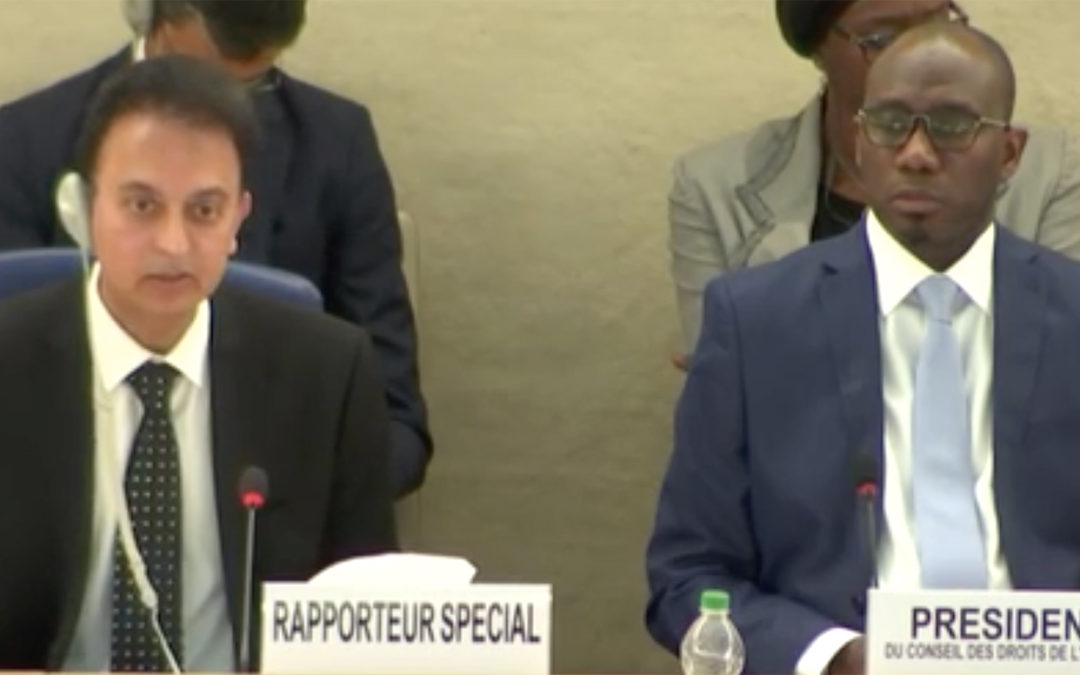
Professor Rehman (pictured addressing the UN Human Rights Council in Geneva on 11 March 2019) said he “deplores” the harassment of BBC Persian staff. His remarks raised concern about the ongoing, collective criminal investigation of BBC Persian staff and the asset-freeze which affects them and their families in Iran. He reiterated the seriousness of the persecution, which was also raised by his predecessor Asma Jahangir, including arbitrary detention and interrogation of family members in Iran. Professor Rehman also raised concern about the attacks on BBC Persian journalists in Iranian state media, in particular with fake and defamatory news being published to undermine their reputations.

The BBC made its unprecedented urgent appeal to the UN in late 2017. It is the first time in BBC history that the BBC has engaged with the UN over the protection of its journalists. Both the UN Special Rapporteur and the UN Secretary-General Antonio Guterres raised concern about the persecution of BBC Persian in their reports to the 40th session of the Human Rights Council.

The UK government mission to the United Nations raised concern with the “deteriorating” situation for freedom of expression in Iran. The UK highlighted that the “judicial harassment of BBC Persian staff and their families continues” and called upon Iran to cease the criminal investigation into BBC journalists and the harassment of their families.

Rana Rahimpour, a BBC Persian presenter (pictured in Geneva with AIB CEO Simon Spanswick), addressed the Council about her personal experience of the persecution, explaining how her father was subjected to a travel ban to prevent him from visiting her after her first child was born. She thanked the UN Secretary General for raising the case and raised concern about the reprisals against BBC Persian staff, explaining that “my colleagues have been warned against participating in our UN advocacy work by the Iranian authorities.”

International counsel for the BBC World Service, Caoilfhionn Gallagher QC and Jennifer Robinson, have filed a further UN complaint over the reprisals BBC Persian journalists have faced for engaging with the UN. They said, “Reprisals against BBC Persian journalists and their families for engaging with the UN is not just an attack on freedom of expression, but an attack on the integrity of the UN system. Such reprisals must be condemned in the strongest possible terms.”

Michelle Stanistreet of the National Union of Journalists said: “The Iranian authorities have been systematically targeting BBC Persian journalists in the UK, and their families in Iran, since the service launched satellite television in 2009. Our campaign to stop the harassment will persist until the authorities stop targeting NUJ members for simply for doing their jobs. Both the asset freeze and criminal investigations into the activities of journalists and other staff working for BBC Persian should be dropped.”

An event was held today at the Human Rights Council co-hosted by the BBC, the International Federation of Journalists and Doughty Street International to discuss the broader implications of the persecution of BBC Persian.

Simon Spanswick from the Association for International Broadcasting – a network of broadcasters that reach one billion viewers and listeners each week – explained how the persecution of BBC Persian is “among the worst cases globally” and is indicative of a worrying trend of harassment of journalists and broadcasters in their network.

At the event, the UK Permanent Representative to the UN in Geneva, Julian Braithwaite, said “UK calls on Iran to cease the harassment of BBC Persian staff and their families – and the persecution of all independent journalists whether affiliated with the BBC or not”. He condemned the reprisals faced by BBC Persian staff.

Referring to the recent media freedom initiative announced by Foreign Secretary Jeremy Hunt, Ambassador Braithwaite said: “This case is one of the reasons we are making press freedom a particular focus for the UK. Iran’s treatment of BBC journalists will be a key part of our upcoming media freedom summit.”

The UN Special Rapporteur Professor Rehman reiterated at the event in Geneva on 12 March: “I will continue to urge Iran to cease its harassment of BBC Persian staff and their families.”
BBC makes unprecedented Human Rights Appeal to UN

BBC makes unprecedented Human Rights Appeal to UN

For the first time in its history, the BBC is making an appeal to the United Nations in Geneva to protect the human rights of BBC journalists and their families. This unprecedented move comes in response to years of persecution and harassment by the Iranian authorities, which escalated in 2017.  

Tony Hall, BBC Director General, said: “The BBC is taking the unprecedented step of appealing to the United Nations because our own attempts to persuade the Iranian authorities to end their harassment have been completely ignored. In fact, during the past nine years, the collective punishment of BBC Persian Service journalists and their families has worsened. This is not just about the BBC – we are not the only media organisation to have been harassed or forced to compromise when dealing with Iran. In truth, this story is much wider: it is a story about fundamental human rights. We are now asking the community of nations at the UN to support the BBC and uphold the right to freedom of expression.” 

Represented by Caoilfhionn Gallagher QC and Jennifer Robinson of Doughty Street Chambers, BBC World Service filed an urgent appeal to UN Special Rapporteurs David Kaye and Asma Jahangir on behalf of BBC Persian staff in October 2017. This week BBC journalists will, for the first time ever, address the Human Rights Council session to call upon member states to take action to protect BBC staff and to ensure their ability to report freely.

Working with the International Federation of Journalists (IFJ), the BBC has organised a series of events during the 37th session of the UN Human Rights Council in Geneva this week about BBC Persian. These activities include a press conference on Monday 12 March and a side event on Thursday 15 March. BBC representatives will address the Human Rights Council as IFJ spokespeople. 

Jeremy Dear, Deputy General Secretary of the International Federation of Journalists, said: “For many years Iranian journalists have suffered; been forced into hiding, fled into exile, been arrested, jailed and subjected to routine harassment, violence and intimidation. Iranians now increasingly turn to the international media to find out what is happening in their own country. Targeting family members in Iran in an attempt to silence journalists working in London must be stopped; the international community must act now.”  

BBC Persian Service journalists in London and their families in Iran have been systematically targeted since the BBC’s satellite television service was launched in 2009. In 2017 the harassment escalated when the Iranian authorities commenced a criminal investigation, alleging BBC Persian Service journalists’ work was a crime against Iran’s national security. This was accompanied by an asset-freezing injunction citing 152 named individuals, comprising mainly of current and former BBC Persian staff, and this injunction prevented journalists and their families from buying or selling their homes and other property in Iran. 

Other measures include the arbitrary arrest and detention of family members in Iran, the confiscation of passports and travel bans preventing people leaving Iran, ongoing surveillance of journalists and their families, and the spread of fake and defamatory news targeting individuals especially women journalists.  

On Monday 12 March in Geneva, the late UN Special Rapporteur for Human Rights in Iran, Asma Jahangir’s report will be tabled and discussed at the Human Rights Council. The report states: 

“In the course of her missions, the Special Rapporteur also met individuals working for the Persian Service of the British Broadcasting Corporation. They described how they and their families in the Islamic Republic of Iran had been harassed by the authorities, and threatened if they continued to work for the Service. Some were arbitrarily arrested, detained, and subjected to travel bans. In August 2017, a court in Tehran issued an injunction banning 152 members of staff, former employees, and contributors from carrying out financial transactions in the country on account of “conspiracy against national security”. Until the time of writing, the injunction has not been lifted and harassment has continued. The Special Rapporteur was disturbed after hearing the accounts of the staff members, observing that many preferred to talk individually and in strict privacy. It has been also reported that some staff members have been photographed while in London to impress upon their families that their relative was being watched. The level of fear that Iranians have whether inside the country or outside of it can be illustrated by the fact that the staff members have endured such intimidation for over twelve months. In October 2017, Special Procedure mandate holders issued a statement calling upon the Islamic Republic of Iran to cease all legal action against the staff and their families, and to cease the use of repressive legislation against independent journalism.”  

At the time of the asset-freezing injunction, the Association for International Broadcasting lodged a complaint with the Iranian Ambassador in London. The AIB received no acknowledgement or response to the complaint.

Human rights and climate change

I attended a debate at the Frontline club on Thursday where there was a discussion on whether human rights should be at the heart of climate change policy.

It raised an interesting perspective that I had not considered before because human rights have an existing international legal framework. So if climate change impacts a person’s (or often those of a community or indigenous group) there is a path for redress. It may be difficult to follow it, because the people affected are usually poor, spend all their time just struggling to survive and would not know about these legal rights, let alone how to pursue them.

But those affected can be empowered (with the help from groups such as LEAD) and they can be helped by powerful advocates such as Amnesty International.

Human rights is another lens through which to view climate change and one that opens up more possibilities for holding to account those who contribute to it – who, of course, can be not only governments and corporations but ourselves as consumers.

Here is a video of the discussion at the Frontline club:
http://www.viddler.com/player/cb188acd/

Roger Stone, AIB