
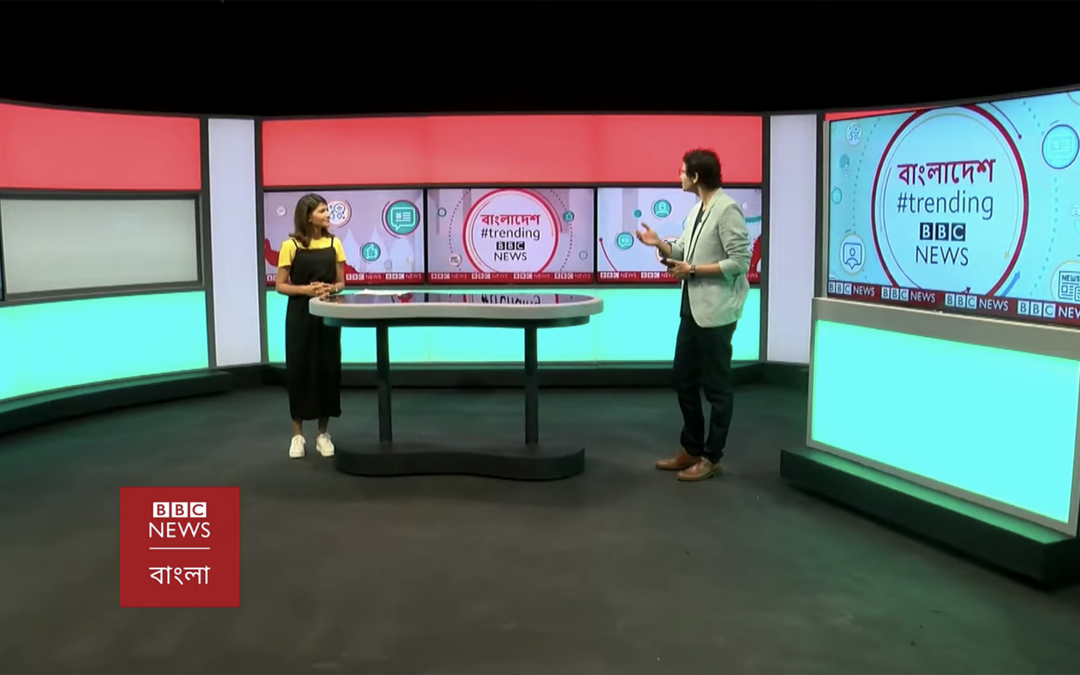
Bangladesh #trending launches from BBC on Channel i

Bangladesh #trending launches from BBC on Channel i
Bangladesh #trending, is a new programme from BBC News Bangla on Channel i, that aims to tap into social-media conversations among young audiences to engage them in discussion of viral and trending topics. Presented by the BBC’s Faisal Titumir, the weekly programme will explore trending topics from different angles as well as fact-checking the rumours that often go viral on social media.
BBC News Bangla editor, Sabir Mustafa, comments: “As Bangladeshi youth increasingly get their news from social media, we realised a need for a programme tailored for these younger audiences – to inform them about the trends and to explore together the truths and the untruths. There will be no topics that are out of reach or are taboo for Bangladesh #trending.”
With what the BBC describes as its slick story-telling, informal chats with young contributors, eye-catching graphics, social-media posts and topical interviews, Bangladesh #trending breaks new ground on the Bangladeshi TV scene. It also further diversifies the BBC News Bangla TV content broadcast by Channel i which broadcasts the current affairs programme, BBC Probaho, and the BBC’s technology programme, Click.
Director and Head of News of Channel i, Shykh Seraj, says: “Channel i has been partnering with BBC for quite a long time, now presenting so many different programmes for the audience. The Bangladesh #trending initiative is going to be a landmark hashtag for people countrywide, and stories will spread even faster as the key topics will come out from the social-media trends that went viral. We will get to discover citizen journalism in the most exciting manner.”
Designed for young audiences, the dynamic show engages social-media activists from across the Bangladeshi socio-economic spectrum in lively debates, providing them with a platform to share their take on trending issues.
In each edition of Bangladesh #trending Faisal Titumir will moderate between two panellists from the programme’s pool of young social-media activists, to explore the week’s trending issues. Audiences will connect with the programme via Facebook and Twitter.
Faisal Titumir is known to those who watch BBC programmes on Channel i or via the BBC News Bangla website or YouTube channel, as the presenter and producer of the BBC’s weekly technology programme, Click. The BBC News Bangla radio listeners know him as a co-presenter of the Social-media Chit-Chat and the weekly sports round-up.
Faisal, who has a major social-media following of his own, says: “Whether they connect with us by social-media posts or by talking directly on our programme, I want to make sure young audiences always see Bangladesh #trending as their platform where we get together to chat, informally and freely, about the week’s trending topics that have touched us.”
Aired by Channel i at 9.35pm Bangladesh time on Mondays – replacing the Monday edition of BBC Probaho – Bangladesh #trending is also streamed via the website bbc.com/bangla and is available on demand via the BBC News Bangla YouTube channel.
BBC News Bangla reaches a weekly audience of 12.6m people (BBC Global Audience Measure 2020) across platforms. Its radio programmes, produced in London and Dhaka, air on the state FM network, Bangladesh Betar, as well as on shortwave and via bbc.com/bangla.